Most people who try a sleep mask and give up on it haven't had a bad experience with sleep masks, they've had a bad experience with a poor one.
A mask that lets light creep in at the edges, presses uncomfortably on the eyelids, or slips off during the night rarely gets a second chance.
And that's a shame, because a genuinely good sleep mask is one of the simplest and most effective things you can add to your sleep routine.
The right one creates a personal pocket of darkness wherever you happen to be sleeping, and once you've tried one that actually works, it's hard to go back.
This guide breaks down what actually matters when choosing one.

Why Light Disrupts Sleep More Than Most People Realise
Before getting into what makes a sleep mask good, it helps to understand why blocking light is worth taking seriously in the first place.
Your body's sleep-wake cycle is regulated largely by melatonin, a hormone produced by the pineal gland in response to darkness. Even low-level light, the kind that barely registers consciously, can signal to the brain that it's time to be awake.
As The Sleep Charity explains, when we're exposed to light, our bodies assume it's time to be alert, which is why artificial light in the evening disrupts our circadian rhythms and makes us feel less sleepy.
That means a street lamp filtering through thin curtains, a standby light on the television, or the faint glow of a phone screen can all interfere with the depth and continuity of your sleep, often without you realising it.
A quality sleep mask addresses this directly. Rather than trying to black out an entire room, it creates a personal pocket of darkness around your eyes, wherever you happen to be sleeping.
What Separates a Good Sleep Mask from a Mediocre One
1. True Blackout Performance
The most important job of any sleep mask is to block light completely. This sounds obvious, but it's where a huge number of masks fall short.
Thin fabric, poor edge sealing, and designs that lie flat against the face all leave gaps where light gets in, particularly around the nose bridge and the sides.
The best masks use a contoured or moulded structure that holds the mask slightly away from the face, creating a seal without pressing directly on the eyes.
This matters both for light blocking and for comfort: a mask that rests on your eyelids can feel restrictive and may interfere with REM sleep, during which your eyes naturally move beneath the lids.
What to look for: A structured or 3D design that cups the eye area, combined with adjustable straps that let you get the fit right without overtightening.
2. Material, and Why It Matters for Your Skin
Fabric choice affects everything from comfort to skin health. Synthetic materials can trap heat, cause sweating around the eyes, and irritate sensitive skin over time. Natural fibres tend to breathe better and feel noticeably gentler.
Silk and bamboo silk have both become popular choices for sleep masks, and for good reason.
They're soft against the skin, regulate temperature more effectively than polyester equivalents, and are generally more suitable for people with sensitive or reactive skin. Bamboo silk in particular tends to be hypoallergenic, making it a considerate choice for anyone prone to irritation.
What to look for: Bamboo silk or natural silk on the inner face of the mask. Be cautious of anything labelled simply as "satin" without specifying the fibre content, this is usually polyester, which behaves quite differently.

3. Fit and Adjustability
A sleep mask only works if it stays put throughout the night. Too tight, and it becomes uncomfortable and may leave marks on the face. Too loose, and it migrates during sleep, letting in light at exactly the wrong moment.
Adjustable elastic straps give you control over fit, which is especially useful if you share a bed and need a mask that won't disturb your partner when you shift positions. Wider straps also tend to be more comfortable than narrow ones, which can dig in or cause hair to snag.
The nose bridge is worth paying attention to as well. A well-designed mask will follow the contours of the face without leaving a gap there, since the nose area is one of the most common places for light to leak through.
What to look for: Adjustable straps, a wide band for comfort, and a nose bridge design that fits closely without pinching.
4. Weight and Breathability
A mask you barely notice you're wearing is the best kind.
Heavy or bulky masks can feel intrusive, particularly if you move around a lot during the night or tend to sleep on your side. Side sleepers in particular benefit from a mask that has some give to it and doesn't press awkwardly into the pillow.
Breathability is also worth considering if you tend to sleep warm. A mask that traps heat around the face can quickly become uncomfortable and disruptive rather than helpful.
What to look for: Lightweight construction with breathable fabric. If you're a side sleeper, try the mask in that position before committing to it, the fit can feel quite different compared to lying on your back.
5. Ease of Care
This is a practical point that often gets overlooked. A mask worn every night will need washing regularly.
Some materials require gentle hand washing only, while others are more resilient. Checking the care instructions before buying is a small step that saves a good deal of frustration later on.
Who Benefits Most from Using a Sleep Mask
Sleep masks are useful for a far wider range of people than you might expect, not just those in particularly bright environments.
If you work shifts and need to sleep during the day, a mask is one of the most effective tools available for mimicking the darkness your body expects at night.
If you travel frequently, a mask makes it far easier to sleep on planes, in hotels, and in unfamiliar rooms where you have no control over the lighting. We go through seat choice, timing and what to pack in our guide on how to sleep on a plane.
Even at home, if early morning light is waking you before you're ready, a mask can meaningfully extend your sleep.
Partners with different sleep schedules also find them invaluable. If one person needs to use a lamp while the other is asleep, a good mask allows both people to coexist far more comfortably in the same space.

Light Is Only Half the Picture
A sleep mask handles light, but sleep quality depends on more than light alone. Noise is often the other significant disruptor, and the two are worth thinking about together.
If both are factors for you, addressing them in combination tends to be more effective than focusing on one in isolation. A soft, well-fitting pair of earplugs worn alongside a good mask can make a genuine difference to how settled and uninterrupted your sleep feels.
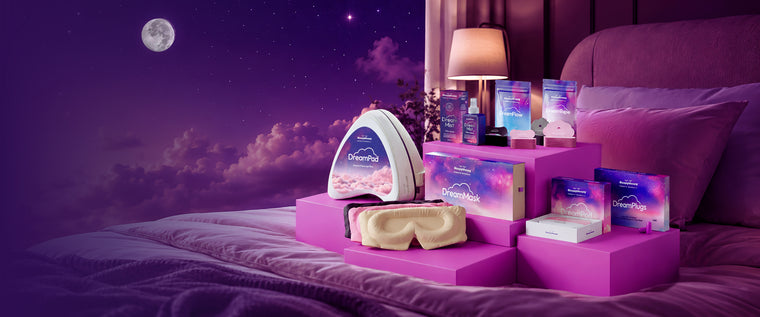
The DreamMask is one we'd genuinely recommend if you're looking for something that addresses everything covered in this guide. It uses a 3D memory foam structure to create a proper blackout cup around the eye area, no pressure on the lids, no light creeping in at the sides.
The inner face is bamboo silk, which stays breathable and soft against the skin throughout the night, and the adjustable straps let you get the fit right without it feeling too tight or too loose.
It's the kind of mask you forget you're wearing. Which is exactly what a good one should be.
Final Thoughts
A good sleep mask isn't a luxury accessory. For many people, it's one of the most straightforward ways to improve the consistency and depth of their sleep without changing anything else about their routine.
The key is finding one that actually blocks light fully, feels comfortable across different sleeping positions, and is made from a material you'd be happy to have against your face every night. Start with those criteria, and the choice becomes far simpler.