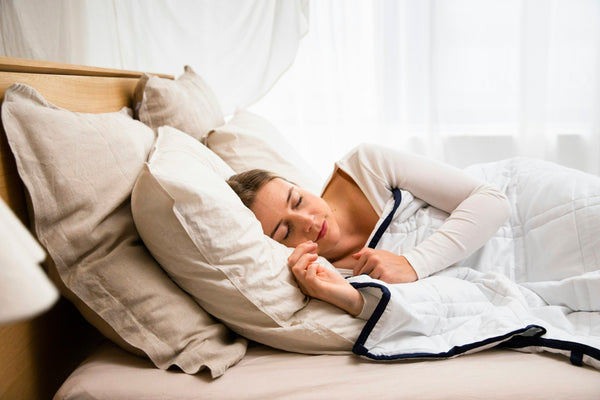

You lie down, the room goes quiet, and for the next seven or eight hours you are, as far as you can tell, doing nothing at all. Then you wake up and something has changed: yesterday's argument feels smaller, the thing you were learning has stuck, your legs have stopped aching from the run. If you have ever wondered what happens when you sleep that could account for all of that, the honest answer is a great deal, and almost none of it is rest.
So what is your body actually doing while you are out, and why does missing an hour or two of it leave you feeling so much worse than the maths suggests? This guide walks through the night stage by stage, explains what gets repaired and filed in each, and finishes with the handful of habits that give your body more of the stages that matter most.

What happens when you sleep?
The short answer. Every night your brain cycles four to six times through light sleep, deep sleep and REM, each cycle lasting about 90 minutes. Across those cycles (1) deep sleep repairs tissue, releases growth hormone and clears waste from the brain, (2) REM sleep files memories and processes emotion, and (3) the whole system resets hormones that govern appetite, stress and immunity.
To be honest, sleep science still has open questions, and the tidy four-stage model is a simplification of something messier. But the broad picture is well established, and it is enough to explain why a short or broken night costs you more than the missing hours. The useful way to think about it is as four jobs the body does in a set order, each with its own stage.
Stage 1: The handover into sleep
The first few minutes are a drift, not a switch. Your muscles loosen, your breathing slows and brain activity shifts from the fast, busy rhythms of wakefulness to slower waves. This is the stage where a text notification can drag you straight back out, and where the odd twitch or jolt happens as the motor system hands over. It lasts five to ten minutes and you will not remember it. It matters mainly because everything that goes wrong here, from a lit-up phone to a racing mind, delays the stages that do the real work. If getting through this stage is your problem, our guide to how to fall asleep faster is the place to start.
Stage 2: Settling in
Your body is now properly asleep, and it is starting the housekeeping. Heart rate and core temperature fall, and the brain produces short bursts of activity called sleep spindles, which seem to protect sleep from outside noise and to begin filing the day's information. You spend roughly half the night in this stage, more than any other. It is light enough that a loud noise will wake you, but deep enough that you are no longer aware of the room. It is the bridge to deep sleep, and a room that is too hot, bright or noisy keeps you stuck here.
Stage 3: Deep sleep, the repair shift
This is where the physical work gets done. Brain waves slow right down, blood pressure drops, and the body releases most of its daily growth hormone, which drives muscle repair and tissue growth. The immune system ramps up, which is why you sleep more when ill and get ill more when you do not sleep. The brain's waste-clearance system also runs hardest now, flushing out by-products that build up during the day. Most deep sleep happens in the first half of the night, so a late bedtime cuts into it disproportionately. We go further in why deep sleep is more important than you think.
Stage 4: REM sleep, the filing shift
The brain wakes up while the body stays paralysed. In REM, brain activity looks close to being awake, your eyes move rapidly behind closed lids, and your major muscles are switched off so you do not act out what you are seeing. This is where most vivid dreaming happens, and where the brain links new memories to old ones and takes the emotional edge off difficult experiences. REM periods get longer as the night goes on, which is why an early alarm steals more REM than deep sleep. Our guide to what REM sleep is covers the detail, and the different stages of sleep explained shows how the four fit together across a night.
Is this you?
You cannot feel your sleep stages directly, but you can feel what happens when one of them is short. See which of these ring true:
- You get eight hours but wake feeling as if you have had five.
- You pick up every cold going round the office.
- Yesterday's stress still feels raw the next morning rather than smaller.
- Things you studied or practised do not seem to stick.
- You are hungrier than usual and reach for sugar and carbs by mid-afternoon.
- Your muscles stay sore for days after a workout that should not have been that hard.
If several of these fit, the total hours may be fine but the deep and REM stages inside them are probably being cut short, and that is fixable.
What to do about it
The fix follows the stage that is being shortchanged, so start with the cheap changes that protect deep sleep and work forward through the night.
Step 1: Protect the first half of the night
This maps to Stage 3. Deep sleep is front-loaded, so the single most effective change is a consistent, reasonably early bedtime. Going to bed at midnight and waking at eight gives you the same hours as eleven to seven but noticeably less deep sleep. Pick a bedtime and a wake time you can hold seven days a week, within half an hour, and give it a fortnight. Our guide to the best time to go to bed helps you choose one that fits your day.
Step 2: Cool, dark and quiet
This maps to Stage 2 and Stage 3. The body needs its core temperature to drop to move from light into deep sleep, so a cool room, around 18 degrees, does more than most gadgets. Light is the other big one: even modest light through the eyelids nudges the brain towards lighter stages and suppresses melatonin. If your bedroom is not properly dark, or your partner reads late, a contoured blackout mask such as the DreamMask blackout sleep mask is the simplest fix, because it gives you darkness without changing the room. It will not add deep sleep on its own, but it removes one of the commonest things that fragments it. Our guide to the best sleep masks in the UK explains what to look for. For noise, soft earplugs do the same job, and the ideal bedroom setup covers the rest.
Step 3: Keep alcohol and caffeine away from the night
This maps to Stage 3 and Stage 4. Caffeine after mid-afternoon delays the handover into sleep and lightens the stages that follow. Alcohol is worse in a sneakier way: it sends you into deep sleep quickly, then suppresses REM and fragments the second half of the night as it wears off. A last coffee by 2pm and alcohol earlier and not every evening will do more for REM than any supplement. The detail is in how caffeine and alcohol quietly ruin your sleep.
Step 4: Give the handover a proper wind-down
This maps to Stage 1. The brain cannot go from a lit screen and a work email to deep sleep in five minutes. Dim the lights for the last half hour, put the phone somewhere else, and do something slow and repetitive. The specific ritual matters less than doing the same one each night, because the repetition becomes the cue. We set one out in how to build a bedtime routine that actually works, and you can browse the tools that help people settle in our fall asleep faster collection.
Step 5: Protect the last hour
This maps to Stage 4. Because REM is back-loaded, the final sleep cycle is mostly REM, and it is the one an early alarm or a snoring partner takes first. If you can, set the alarm for the end of a cycle rather than the middle, which usually means 7.5 or 9 hours after you fell asleep rather than 8. If you cannot move the alarm, move the bedtime. And if something else is waking you early, whether noise, light or a full bladder, deal with that directly rather than accepting the lost hour.
"I can catch up on sleep at the weekend" - is that true?
Up to a point. A long lie-in after a short week does pay back some deep sleep, because the body prioritises it when it gets the chance. What it does not do is restore the REM and the daytime function you lost on Tuesday, Wednesday and Thursday, and research on recovery from a run of short nights suggests reaction time and mood take several days to return to baseline even with unlimited sleep. The bigger cost is that sleeping until eleven on Sunday shifts your body clock later, which makes Sunday night harder and Monday morning worse. A modest lie-in of an hour is fine. Treating the weekend as a repayment plan is not, and our guide to sleep deprivation and how to recover explains what actually works.
When it's different for you
- If you work shifts: your stages are the same but the clock that schedules them is fighting the daylight. Darkness and consistency across your shift pattern matter more than any single tip here, and we cover it in shift work and sleep.
- If you are pregnant: deep sleep naturally falls in the third trimester and waking is normal. Focus on comfort and position rather than chasing stage targets; see sleep during pregnancy.
- If you are over 60: deep sleep declines with age and waking more often is expected. That is not a problem to fix so much as a reason to protect the deep sleep you do get with the first two steps.
- If you use a sleep tracker: consumer devices estimate stages from movement and heart rate and are often wrong about deep and REM by a wide margin. Use the trend, not the nightly number, and read what is core sleep before you worry about a score.
Frequently asked questions
How many sleep cycles do you need a night?
Most adults get four to six cycles of roughly 90 minutes, which is where the seven to nine hour recommendation comes from. Five full cycles is about seven and a half hours. You do not need to count them, but it helps to know that waking mid-cycle, especially out of deep sleep, is what causes that heavy, groggy feeling. Our guide to how much sleep you really need goes into the individual range.
What happens if you never get deep sleep?
Almost everyone gets some, but people who consistently get too little report slower physical recovery, more frequent infections, worse memory and a foggy, unrefreshed feeling on waking even after a long night. Deep sleep is also when the brain clears metabolic waste, so chronic shortfall is being studied for its longer-term effects. The good news is that the body defends it fiercely: shorten it one night and you will get more the next.
Does a sleep mask really help you get more deep sleep?
Indirectly. A mask does not create deep sleep, but light through the eyelids is one of the most common things that lifts you out of it into lighter stages without fully waking you. Removing that light with a comfortable blackout mask such as the DreamMask tends to make sleep less fragmented, which is what lets the deeper stages run their full length. It works best alongside a consistent bedtime, not instead of one.
Why do I remember some dreams and not others?
You remember a dream when you wake during or just after a REM period, which is why the dreams you recall are usually from the last hour before the alarm. Dreams from earlier cycles happen but are rarely stored because the memory systems that would file them are running differently. That is also why a broken night often feels more dream-heavy: you are simply surfacing more often. There is more in why do we dream.
Is it bad to wake up in the night?
No. Brief wakings between cycles are a normal part of how sleep is built, and most people have several a night without remembering them. It only becomes a problem when you stay awake, start clock-watching or wake at the same time every night, which usually has a specific cause. If that is you, our guide to why you wake up at 3am walks through the likely reasons.

The bottom line
What happens when you sleep is a set of jobs in a set order: settle, repair, file, reset. Protect the first half of the night for deep sleep with a consistent bedtime, keep the room cool and dark, keep alcohol and caffeine away from the evening, give the handover a proper wind-down, and protect the last hour for REM. Most people feel the difference within a fortnight of the first two alone.
Accept that no night is perfect and that a few brief wakings are how sleep is meant to work. Do not chase a tracker score. If you are doing the basics and still waking unrefreshed for weeks, or you are exhausted in the day despite a full night, something else is going on and it is worth a conversation with your GP.
Try the DreamMask Blackout Sleep Mask - total darkness for the stages that need it, whatever the room is doing.
This article is general information, not medical advice. If your symptoms are persistent or severe, or you are unsure what is causing them, please speak to your GP. SleepyDeepy products are designed to support your sleep and are not a treatment for any medical condition.
Sleep deeply. Wake sharper. SleepyDeepy.