
Here is something most people never think about: how you breathe while you are asleep. Not how deeply, not how often. Just which hole the air comes in through.
It sounds trivial. It is not. Whether you breathe through your nose or your mouth during sleep is one of the more consequential things happening in your body overnight - and for a large proportion of adults, the wrong one is happening, silently, every single night.
What nasal breathing actually does
The nose is not just a passage for air. It is an active processing system with several jobs that the mouth simply cannot replicate.
First, it filters. The tiny hairs and mucous membranes inside the nose trap dust, allergens, bacteria and other particles before they reach the lungs. The mouth has no equivalent mechanism - everything goes straight in.
Second, it conditions the air. The nose warms and humidifies incoming air so that by the time it reaches the lungs it is closer to body temperature and saturated with moisture. Breathing cold, dry air directly through the mouth irritates the airways and dries out the throat.
Third - and this is the one most people have not heard of - the nose produces nitric oxide. This molecule is released from the sinuses during nasal breathing and travels down into the lungs, where it dilates blood vessels and improves oxygen transfer into the bloodstream. Nasal breathers absorb oxygen more efficiently than mouth breathers, even breathing the same air at the same rate.
Fourth, nasal breathing encourages slower, steadier breathing. The resistance created by the nose naturally slows the breathing rate, which activates the parasympathetic nervous system - the part responsible for rest, recovery and sleep. Mouth breathing bypasses this resistance and tends to produce faster, shallower breathing patterns that keep the body in a mild state of arousal.
What mouth breathing does instead
When the mouth is open during sleep, the soft tissue at the back of the throat - the soft palate and uvula - becomes the primary obstruction in the airway. As air rushes past this tissue, it vibrates. That vibration is snoring.
Mouth breathing also dries out the throat and mouth significantly. The saliva that normally coats and protects the mucous membranes evaporates, leaving the tissues inflamed and irritated. This is why mouth breathers consistently wake with a dry mouth, sore throat, or unpleasant breath regardless of how thoroughly they brush their teeth the night before.
Beyond the throat, mouth breathing during sleep is associated with more fragmented sleep architecture. Studies have found that mouth breathers spend less time in the deeper, restorative stages of sleep, and report feeling less refreshed in the morning even after sleeping for a full seven or eight hours. The body is technically asleep, but it is not recovering as efficiently as it should.
In children, chronic mouth breathing has been linked to changes in facial development, dental problems, and behavioural issues associated with poor sleep. In adults, the consequences are less visible but equally real: chronic fatigue, elevated cortisol, and impaired immune function are all associated with the fragmented, lighter sleep that mouth breathing tends to produce.
How do you know if you are mouth breathing at night?
Most people are not aware of it happening. By definition, you are asleep. But there are reliable signs:
- Waking with a dry mouth or sore throat, consistently
- Bad breath in the morning that does not correspond to what you ate
- Being told you snore, or being aware that you do
- Waking with a headache, particularly across the forehead
- Feeling unrefreshed in the morning despite sleeping enough hours
- Needing to drink water immediately on waking
- Waking with a stuffy nose despite not being congested when you went to bed
If several of these sound familiar, mouth breathing is the likely explanation.
That last one is worth noting. Paradoxically, sleeping with your mouth open can cause nasal congestion rather than relieve it. When the mouth is open, the body reduces airflow through the nose as a compensatory mechanism. Close the mouth and the nose often clears on its own within minutes.
Why people mouth breathe at night
There are several common causes. Nasal congestion from allergies or a cold is the most obvious - when the nose is blocked, the mouth becomes the default. But many people mouth breathe even when their nose is perfectly clear, because it has become a habitual pattern established during childhood illness and never corrected. Others have a slightly narrow nasal passage or mild anatomical restriction that makes mouth breathing feel easier at low levels of consciousness.
Sleeping position plays a role too. Lying on the back allows the jaw to fall open naturally. Side sleepers are less prone to mouth breathing, partly because gravity keeps the jaw closed and partly because lateral positioning improves airway tone.
How to switch to nasal breathing at night
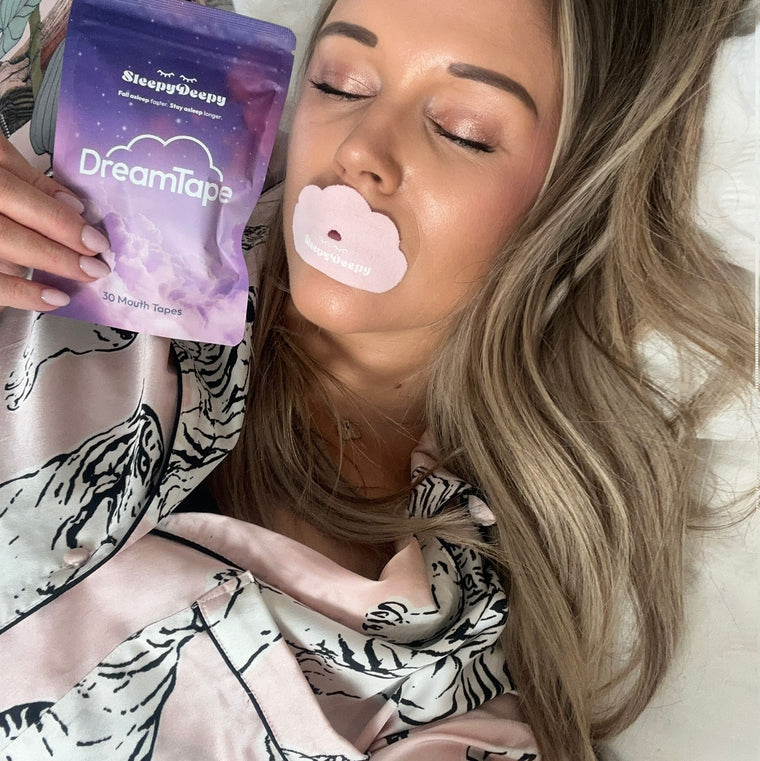
The most direct intervention is to keep the mouth physically closed. Mouth tape does exactly this - a small adhesive strip across the lips holds the mouth shut overnight, removing the option of mouth breathing entirely. The body defaults to nasal breathing, nitric oxide production resumes, and the throat stays moist.
This sounds counterintuitive - even slightly alarming - until you understand that the nose is always capable of meeting the body's breathing demand during sleep, provided it is not severely congested. The vented design of DreamTape addresses the safety concern directly: a small gap in the centre of the strip allows emergency mouth breathing if needed, making it a practical starting point for anyone new to the approach. If you are weighing up your options, we compare the best mouth tapes in the UK to help you decide what suits you.
If the nose feels restricted - not blocked, but just insufficiently open - combining mouth tape with nasal strips is the more complete solution. An external nasal strip widens the nasal passage by gently pulling the sides of the nose outward, reducing the resistance that makes nose breathing feel effortful. The two used together create the conditions for what researchers call nasal-only breathing: mouth closed, nose open, airway clear.

Most people notice a difference within the first few nights. Dry mouth disappears. Snoring reduces significantly or stops. Morning grogginess - the kind that persists even after coffee - often lifts within a week or two as sleep architecture improves.
Is it safe?
Nasal breathing during sleep is the default human state. It is how the body is designed to function. Mouth breathing is the deviation, not the other way around. Encouraging a return to nasal breathing overnight is not an intervention - it is a correction.
Mouth tape is not appropriate for people with severe nasal obstruction, obstructive sleep apnea (without medical guidance), or significant respiratory conditions. If you have any concerns, speak to your GP before starting. For the majority of healthy adults who mouth breathe out of habit or mild anatomical tendency, it is a safe and effective tool.
The short version
Nasal breathing produces nitric oxide, filters and conditions air, and supports the slow breathing pattern associated with deep sleep. Mouth breathing does none of these things, dries out the throat, increases snoring, and produces lighter, more fragmented sleep.
If you regularly wake with a dry mouth, snore, or feel unrefreshed in the morning, mouth breathing is the most likely common cause - and it is one of the easier things to address. Close the mouth, open the nose, and give the body the conditions it needs to actually recover overnight.
Shop DreamTape Mouth Tape | Shop DreamFlow Nasal Strips
Sleep well. Sleep properly. SleepyDeepy.