The sleep product market is enormous, and most of it is noise. Weighted blankets with dubious claims, supplements that do little beyond their placebo effect, devices that cost a fortune and gather dust within a fortnight.
Knowing what actually makes a difference, and what's just clever packaging, can feel like a full-time job.
So we've cut through it.
Below are seven sleep aids that have a clear, evidence-backed reason to work, solve a real and common sleep problem, and are straightforward enough that you'll actually use them every night.
No gimmicks, no fads, just tools that earn their place in your routine.

1. DreamMask — Bamboo Silk Blackout Sleep Mask
Light is one of the most disruptive forces in the sleep environment, and one of the most underestimated. Even low-level ambient light, a street lamp through thin curtains, a standby light on the television, can suppress melatonin production and prevent your brain from fully committing to sleep.
A blackout sleep mask is the simplest possible fix, and the DreamMask does it properly.
What sets it apart from cheaper alternatives is the 3D memory foam structure. Rather than pressing flat against your eyes, it forms a contoured cup around the eye socket, blocking light completely without any pressure on the eyelids.
This matters for REM sleep, during which your eyes move naturally beneath the lids, and a flat mask can feel genuinely restrictive.
The inner face is bamboo silk: breathable, temperature-regulating, and soft enough that most people forget they're wearing it. Adjustable straps make it suitable for all head sizes and sleeping positions.
If you've tried sleep masks before and given up on them, the DreamMask is almost certainly a different experience to whatever you used previously.
Best for: Anyone affected by ambient light, early morning sun, or shared sleeping spaces where someone else keeps a light on.

2. DreamTape — Mouth Tape for Nasal Breathing
Mouth breathing during sleep is far more common than most people realise, and its effects, dry mouth, disrupted sleep cycles, snoring, waking up unrested, are frequently attributed to everything except the actual cause.
Mouth tape works by gently encouraging the lips to stay closed during sleep, allowing the body to breathe nasally as it's designed to.
Nasal breathing produces nitric oxide, warms and filters incoming air, and results in measurably better sleep quality for most people who make the switch.
The benefits are well established, and for anyone who regularly wakes with a dry or sore throat, the improvement is usually noticeable from the first night.
DreamTape is made from a soft, skin-safe material with a gentle hold that keeps the lips lightly closed without any discomfort or skin irritation. It's not the stationery tape some early adopters misguidedly tried, it's specifically designed for overnight use, and the difference shows.
Best for: Mouth breathers, snorers, and anyone who wakes up with a dry mouth or throat.

3. DreamFlow — Nasal Strips for Easier Breathing
For people whose sleep is disrupted by restricted nasal airflow, whether from a naturally narrow passage, mild congestion, or a deviated septum, a nasal strip can make a surprising amount of difference.
DreamFlow nasal strips sit across the bridge of the nose and gently widen the nasal passages, reducing resistance and making nasal breathing feel effortless throughout the night.
The effect is immediate and physical: less resistance means less effort, which means a more relaxed airway, quieter breathing, and fewer of the micro-arousals that fragment sleep without ever fully waking you.
Used alone, or alongside DreamTape for anyone tackling mouth breathing from both angles, DreamFlow is a practical, non-invasive option that needs no adjustment period.
Best for: People who snore, sleep with congestion, or feel as though they can't breathe freely through their nose at night.

4. DreamPod — Bone Conduction Pillow Speaker
Sound is a highly effective sleep tool, but how you deliver it matters enormously. Earbuds are uncomfortable to sleep in, particularly for side sleepers. Speakers fill the room with sound that disturbs a partner.
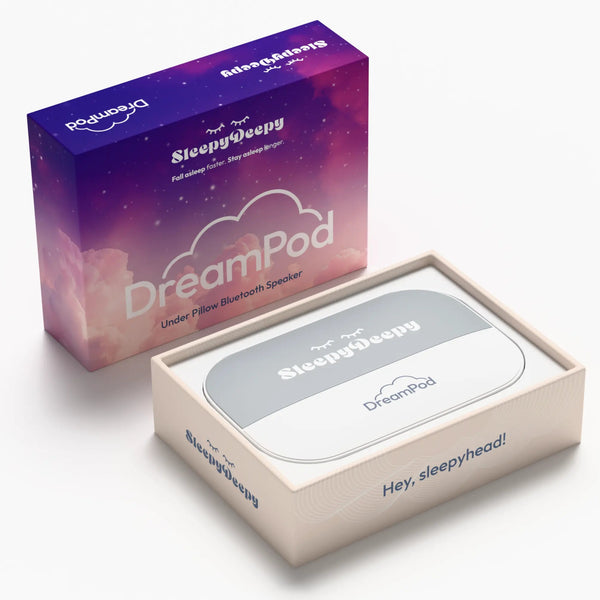
The DreamPod solves this elegantly: it's a wireless Bluetooth speaker that sits beneath your pillow and uses bone conduction to deliver audio directly to the listener, quietly and privately, without anything in the ear.
White noise, pink noise, rainfall, guided meditations, sleep podcasts, audiobooks, the DreamPod makes all of them accessible in a way that's genuinely comfortable for overnight use.
For people whose minds tend to race at bedtime, or who find silence counterproductive, having a reliable audio option without earbuds or room-filling speakers can be transformative. It's also exceptionally useful for partners with different sleep schedules, where one person needs audio and the other doesn't.
Best for: Anyone who uses sound to fall asleep, light sleepers disturbed by silence, and people who share a bedroom with a partner.

5. DreamPlugs — Soft Foam Earplugs
Noise is consistently one of the most-cited causes of disrupted sleep, traffic, neighbours, a snoring partner, early morning bin lorries. And the solution is, genuinely, one of the simplest and most affordable things on this list.
A good pair of foam earplugs worn correctly can reduce noise by up to 33 decibels, which is enough to make a meaningful difference in almost any environment.
DreamPlugs are made from a soft, slow-rebound foam that compresses for insertion and then gently expands to seal the ear canal, comfortable enough to wear through the night without the soreness that cheaper, firmer foam plugs tend to cause.
At under £9 a box, they're also the most cost-effective item on this list by a significant margin. The fact that so many people who struggle with noise-related sleep disruption haven't tried properly fitting earplugs remains one of the great missed opportunities in sleep health.
Best for: Anyone affected by environmental noise, snoring partners, light sleepers, and shift workers sleeping during the day.

6. DreamMist — Lavender Pillow Spray
Scent is not a gimmick when it comes to sleep. The olfactory system has a direct neural pathway to the limbic system, the part of the brain responsible for emotion and memory, which is why certain smells can produce an almost immediate physical sense of calm.
Lavender, specifically, has a reasonable body of evidence behind its relaxing properties, making a quality pillow spray a legitimate part of a wind-down routine rather than a wellness affectation.
DreamMist combines lavender with chamomile and vanilla, a blend that sits at the calmer end of the aromatic spectrum and doesn't overpower the room.
A few spritzes onto the pillow or bedding five to ten minutes before sleep works both as a sensory cue (training the brain over time to associate the scent with sleep) and as an immediate relaxant. It's a small, inexpensive, and genuinely pleasant addition to a bedtime routine.
Best for: People with busy or anxious minds at bedtime, those building a wind-down routine, and anyone who finds sensory cues helpful for signalling sleep.

7. DreamPad — Ergonomic Memory Foam Knee Pillow
Side sleepers make up the majority of the adult population, yet the standard sleep setup is largely designed with back sleepers in mind.
Without support between the knees, side sleeping places the hips out of alignment and can create or worsen lower back pain, hip discomfort, and interrupted sleep. An ergonomic knee pillow is a simple, physical fix that addresses the root cause directly.
The DreamPad is contoured from memory foam to sit naturally between the knees, keeping the hips, spine, and pelvis in proper alignment throughout the night. The difference for people who wake with lower back stiffness or hip pain is often immediate, not because the foam has any magical property, but because the body is finally in the position it's supposed to be in.
Compact, washable, and designed to stay in place, it's the kind of product that makes you wonder why you didn't try it sooner.
Best for: Side sleepers, anyone with lower back or hip discomfort, and people who find themselves shifting position frequently in search of comfort.

A Quick Note on Building a Sleep Kit That Works for You
None of the products above require a major lifestyle change or a complicated new routine.
Each one addresses a specific, common sleep problem, light, breathing, noise, discomfort, an overactive mind, and can be used independently or in combination depending on what's actually getting in the way of your sleep.
If you're not sure where to start, it's worth thinking about what your sleep problems actually are.
- Waking up with a dry mouth? Start with DreamTape.
- Affected by noise? DreamPlugs.
- Light sensitivity? The DreamMask.
- Difficulty switching off at bedtime? DreamMist and DreamPod together make a good pairing.
There's also a quick DreamBuilder quiz on the SleepyDeepy site that can help you identify your best starting point in about 60 seconds.
Better sleep rarely requires a complete overhaul. More often, it just needs the right tool for the right problem.